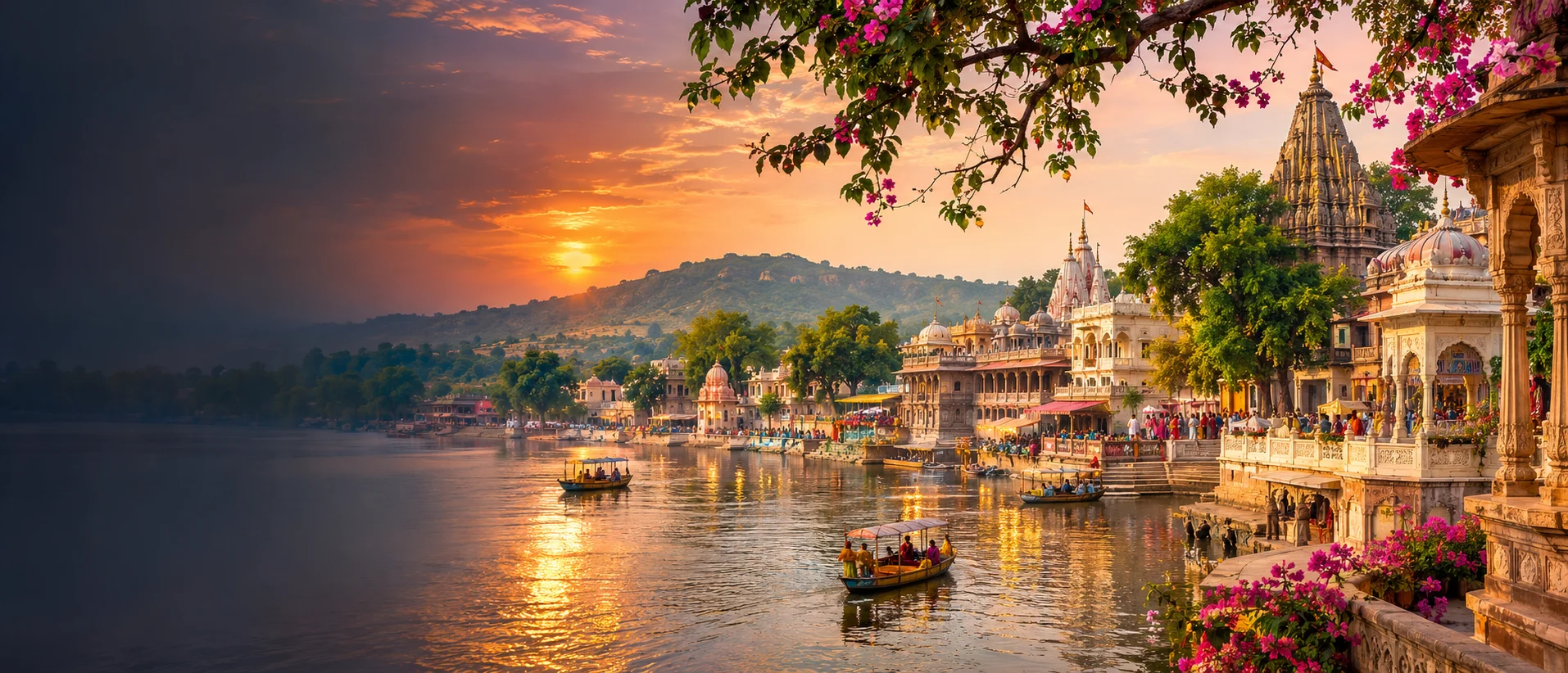
Sacred memory
A forest named Vṛndāvana
In the Bhāgavata Purāṇa, Upananda describes Vṛndāvana as a pastoral woodland of grasses, vines, hills and gardens—a place suited to the people and cattle of Vraja.
Bhāgavata Purāṇa 10.11.28
A town beside the Yamuna. A landscape held in sacred memory. A living city whose future is still being written.
Not only a destination
To speak of Vrindavan is to move between evidence and devotion without confusing them: the geography of a town, the history of its temples, the sacred narratives that shaped its meaning, and the everyday lives that continue there.
This guide keeps those layers in conversation—offering the devotional tradition with respect, and the historical record with care.
02 / The land
Vrindavan is in Mathura district, Uttar Pradesh, on the Yamuna. State tourism places it about 15 kilometres from Mathura; the district overview gives a distance of about 11 kilometres. The difference reflects how distances are measured, so think of Mathura as a nearby neighbour, not a fixed travel time.12
The wider Braj landscape is cultural as much as administrative: its places are connected through pilgrimage, stories, language and shared traditions. Vrindavan is one town within that larger world.
Explore the wider Braj region03 / A layered history
Vrindavan’s story cannot be reduced to one founding date. Sacred narrative, temple histories and living lineages preserve different kinds of memory.
Sacred memory
In the Bhāgavata Purāṇa, Upananda describes Vṛndāvana as a pastoral woodland of grasses, vines, hills and gardens—a place suited to the people and cattle of Vraja.
Bhāgavata Purāṇa 10.11.28Early modern bhakti
The Chaitanya-caritāmṛta recounts Chaitanya Mahaprabhu’s journey through Vṛndāvana. The devotional account remembers the landscape not as scenery, but as a place encountered through song, pilgrimage and līlā.
Chaitanya-caritāmṛta, Madhya 17–18Around 1542
The Mathura district tourism record dates the construction of Radha Raman Temple to around 1542 and associates it with Gopāla Bhaṭṭa Gosvāmī.
Mathura District AdministrationThe living city
Vrindavan continues as a pilgrimage town with historic and modern temples, neighbourhoods, daily worship and changing visitor needs.
Uttar Pradesh Tourism04 / Scripture & language
A careful answer starts by distinguishing the Vedas from the Purāṇas. The detailed Krishna-in-Braj narratives most readers associate with Vrindavan are found in Purāṇic literature—especially the Bhāgavata Purāṇa’s Tenth Canto—not as a Vrindavan travel account in the four Vedas.
A useful distinction. “Vedic” is sometimes used broadly for Hindu sacred tradition. Bibliographically, however, the Bhāgavata Purāṇa is a Purāṇa. The verses below are Purāṇic ślokas, not Vedic hymns.
Sanskrit · Devanāgarī
वनं वृन्दावनं नाम
पशव्यं नवकाननम् ।
गोपगोपीगवां सेव्यं
पुण्याद्रितृणवीरुधम् ॥
IAST transliteration
vanaṁ vṛndāvanaṁ nāma
paśavyaṁ nava-kānanam ।
gopa-gopī-gavāṁ sevyaṁ
puṇyādri-tṛṇa-vīrudham ॥
A woodland named Vṛndāvana: fresh groves, hills, grasses and vines—a fitting home for the cowherds, their families and their cattle.
Read the Sanskrit sourceSanskrit · Devanāgarī
वृन्दावनं सखि भुवो वितनोति कीर्तिं
यद् देवकीसुतपदाम्बुजलब्धलक्ष्मि ।
गोविन्दवेणुमनुमत्तमयूरनृत्यं
प्रेक्ष्याद्रिसान्ववरतान्यसमस्तसत्त्वम् ॥
IAST transliteration
vṛndāvanaṁ sakhi bhuvo vitanoti kīrtiṁ
yad devakī-suta-padāmbuja-labdha-lakṣmi ।
govinda-veṇum anu matta-mayūra-nṛtyaṁ
prekṣyādri-sānv-avaratānya-samasta-sattvam ॥
Friend, Vrindavan spreads the earth’s renown, blessed by Krishna’s lotus feet. As Govinda’s flute sounds, peacocks dance and the creatures on the hills grow still to watch.
Read the Sanskrit sourceTranslations are concise editorial renderings from the cited Sanskrit, offered for orientation rather than as a substitute for a published edition.

05 / Voices & lineages
Rather than inventing quotations, this page follows named voices in texts and temple histories—and labels devotional tradition as tradition.
Bhāgavata Purāṇa · 10.21.10
Their song gives Vrindavan a voice: its glory is carried by Krishna’s presence, the flute, dancing peacocks and a landscape that seems to listen.
Follow the sourceChaitanya-caritāmṛta · Madhya 17–18
The devotional biography remembers his travels through Vrindavan and his response to its forests and living beings. This is a hagiographic account, read here as devotional memory.
Follow the sourceTemple tradition · Nidhivan
The district’s Banke Bihari account connects Swami Haridas with the image’s early worship at Nidhivan. We present this as a temple tradition, not as an independently dated archival claim.
Follow the sourceA modern, global legacy
A. C. Bhaktivedanta Swami Prabhupada carried a Gauḍīya Vaiṣṇava reading of the Bhagavad-gītā to new readers through his English translation and commentary, Bhagavad-gītā As It Is. The Bhaktivedanta Book Trust (BBT) records that an abridged edition appeared through Macmillan in 1966 and that Prabhupada later established the Trust to publish his works.10
Today, the BBT says it publishes his books in an expanding number of languages.11 ISKCON and the BBT describe a shared effort to teach, study, and distribute those works.12 Together, they helped carry Krishna-bhakti and one distinct interpretation of the Gītā to readers around the world—part of the text’s modern global reception, alongside its many other translations and traditions.
A verse remembered by Chaitanya Mahaprabhu
Bhāgavata Purāṇa 10.13.60 · recalled in Chaitanya-caritāmṛta, Madhya 17.39
Sanskrit · Devanāgarī
यत्र नैसर्गदुर्वैराः
सहासन् नृमृगादयः ।
मित्राणीवाजितावास-
द्रुतरुट्तर्षकादिकम् ॥IAST transliteration
yatra naisarga-durvairāḥ
sahāsan nṛ-mṛgādayaḥ ।
mitrāṇīvājitāvāsa-
druta-ruṭ-tarṣakādikam ॥In that abode, those naturally at odds—people and animals—live like friends; anger, thirst and the like fall away.
Bhāgavata text Chaitanya narrative
06 / The mahimā
In the devotional vision of the Bhāgavata, Vrindavan is not a backdrop to a story. The groves, river, hills, birds and creatures take part in its meaning. The gopīs’ song calls the place glorious because Krishna’s presence is felt through the whole landscape.6
That is one way to understand its mahimā: not simply as a sacred address, but as a relationship between land, memory, devotion and the lives that continue to honour it.
07 / The living present
Today, Vrindavan holds old and modern temples, worship, pilgrimage, neighbourhood life and visitor services in the same city. Its story is not sealed in the past; it is made daily.
The present
Darshan, festivals, seva, local work and the rhythms of residents sit alongside the needs of visitors. Uttar Pradesh Tourism describes Vrindavan as a major pilgrimage place with both old and modern temples.1
To understand the town, look beyond monuments: notice how people care for places, pass on traditions, make a living and share public space.
The future
The future is not a prediction. It is a responsibility: to keep the Yamuna central to the city’s life, care for historic places, make pilgrimage gentler on neighbourhoods, and keep local voices present in decisions.
Vrindavan’s next chapter can honour its sacred memory while making room for ecological care, living culture and a dignified everyday city.
Vrindavan is at once a place on a map, a place in scripture, and a place made meaningful by the people who live, worship and remember there.
08 / Read further
We use official tourism records for present-day place information and link directly to the primary devotional texts quoted above. Sacred narratives are presented as sacred narratives, not as archaeological dates.
State tourism overview of the pilgrimage town and its old and modern temples.
Official district context and approximate proximity between Mathura and Vrindavan.
District tourism record for the temple and its association with Gopāla Bhaṭṭa Gosvāmī.
District tourism account of the temple’s devotional tradition and Swami Haridas.
Primary Sanskrit text describing Vṛndāvana as a pastoral woodland.
Primary Sanskrit text of the gopīs’ song glorifying Vṛndāvana.
Devotional narrative of Chaitanya Mahaprabhu’s journey and visit to Vṛndāvana.
Primary Sanskrit text of a verse about friendship among beings in Vṛndāvana.
The narrative recounts Chaitanya Mahaprabhu remembering this Bhāgavata verse.
The BBT’s account of Prabhupada’s early publishing work, Bhagavad-gītā As It Is, and the Trust’s founding.
The BBT describes its role as publisher of Prabhupada’s books and their publication in an expanding number of languages.
The BBT’s account of how ISKCON communities teach, study, and distribute the books.
Continue with care